
How Do Hydraulic Pumps Work
How Do Hydraulic Pumps Work?
Hydraulic pumps operate on the positive displacement principle. They apply pressure to a confined fluid through reciprocating or rotary motion. The driving force is supplied by a prime mover—such as an electric motor, internal combustion engine, human power, or compressed air—which drives an impeller, gears, or vanes to create fluid flow inside the pump housing.
The pump creates a vacuum at the inlet through mechanical action, allowing atmospheric pressure to push fluid into the pump. The fluid then forms a negative pressure in the inlet chamber before being forced under high pressure toward the pump outlet.
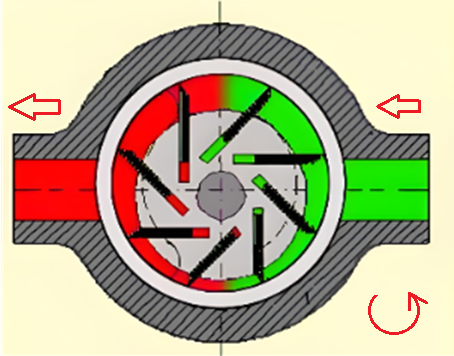
Different types of pumps—gear pumps, vane pumps, piston pumps, and others—generate fluid flow and pressure through their distinct internal structures.
- Gear pumps: Two meshing gears rotate in opposite directions, creating expanding and contracting chambers that generate fluid flow and pressure.
- Vane pumps: Vanes extend outward under centrifugal force and are pushed back into the rotor as they pass the inlet and outlet ports, thereby producing fluid flow and pressure.
- Piston pumps: Pistons reciprocate inside cylinders, creating chambers of varying volume that draw in and pressurize fluid, generating flow and pressure.
Pump performance depends on the size and shape of the internal chambers, the operating speed, and the input power. Hydraulic pumps use incompressible fluids as the working medium, typically mineral oil or food-grade alternative fluids. The working fluid must provide lubrication and be capable of operating at elevated temperatures. Fluid selection depends on safety requirements, such as fire resistance or suitability for food-processing environments.
Types of Hydraulic Pumps
Hydraulic pumps come in many varieties and can be classified according to the following dimensions:
- By power source
- By mode of action
- By positive-displacement category
Classification by Power Source
- Pneumatic hydraulic pumps: Compact design and no need for an external electrical supply; however, a stable compressed-air source is required, and output pressure is limited by the available air supply pressure.
- Electric hydraulic pumps: Provide stable and efficient power and are easy to integrate into existing systems. Disadvantages include the need for continuous electrical supply (power outages stop operation), additional electrical safety measures, and higher purchase cost compared with other types.
- Fuel-powered hydraulic pumps: Portable units suitable for outdoor and remote-site work. Drawbacks include dependence on fuel supply, higher emissions, and the need for regular maintenance of the fuel system.
- Manual hydraulic pumps: Easy to transport and require no power source; output flow is limited by the operator’s physical strength, and work cycles take longer.
Classification by Mode of Action
Hydraulic pumps are divided into single-acting and double-acting types.
- Single-acting pumps: Have only one oil port; hydraulic oil enters through this port to extend the cylinder.
- Double-acting pumps: Have two oil ports—one controls cylinder extension and the other controls retraction.
Working Principle
- Single-acting: Hydraulic oil enters the cylinder and causes it to extend; retraction is achieved by a spring, gravity, or the load’s own weight.
- Double-acting: When hydraulic oil enters the upper port, the cylinder retracts and the component returns to its original position.
Application Scenarios
- Single-acting pumps: Suitable for simple applications that require only unidirectional linear motion, such as lifting objects or pressing workpieces.
- Double-acting pumps: Used in equipment that requires precise bidirectional linear motion, such as elevators and forklifts.
Three Main Categories of Positive-Displacement Pumps: Gear, Vane, and Piston
- Pressure: Gear and vane pumps are suited to low-pressure applications; piston pumps are designed for high-pressure duty.
- Cost: Gear pumps have the lowest purchase and maintenance costs; piston pumps are the most expensive; vane pumps fall in between.
- Efficiency: Gear pumps have the lowest efficiency, typically around 80% (i.e., 10 hp of mechanical input yields approximately 8 hp of hydraulic power); vane pumps are more efficient than gear pumps; piston pumps offer the highest efficiency, reaching up to 95%.
Common Applications
Hydraulic pumps are widely used across many industries.
- Automotive industry: Used with jacks and engine hoists to lift vehicles, platforms, and heavy components, as well as for engine removal and installation.
- Machine shops: Provide power for cutting, drilling, pressing, and pulling tools.
- Woodworking shops: Hydraulic jacks power log splitters.
- Process and manufacturing industries: Heavy-duty hydraulic pumps drive tapping operations, large valve actuation, fastening, and expanding processes.
- Heavy construction equipment: Excavators, cranes, loaders, tractors, and other large machines.
- Production facilities: Conveyors, mixing equipment, and forklifts.
How to choose?
Although the internal mechanisms of hydraulic pumps differ, they can generally be categorized by output pressure rating and drive method (manual, pneumatic, electric, or fuel-powered). Selecting the right hydraulic pump requires consideration of several key parameters:
- Operating pressure: Determine the system’s maximum working pressure and the minimum pressure needed to overcome the load.
- Drive method: Choose between manual (hand or foot operated), air-compressor driven, electric motor driven, or fuel-engine driven. Also consider the need for remote operation, work speed, and load requirements.
- Work speed: For manual pumps, confirm whether single-speed or two-speed operation is required and the volume of oil delivered per handle stroke. For power-driven pumps, determine the required flow rate in liters (or gallons) per minute. Pneumatic, fuel, and electric pumps are better suited to high-flow applications.
- Portability: Manual pumps are portable but limited in output capacity. Fuel-powered pumps deliver high pressure and are ideal for field work without electricity, but they are relatively heavy. Electric and pneumatic pumps can be used either as mobile units or fixed installations; pneumatic pumps require an on-site compressed-air supply.
- Operating temperature: Ambient temperature affects reservoir sizing, fluid selection, and the materials used for pump components. In heavy-duty systems the hydraulic fluid also serves as a cooling medium.
- Load stroke: The distance the load must travel determines reservoir size and the number of cylinders required.
- Operating noise: Consider site noise restrictions. At comparable ratings, fuel-powered pumps are generally louder than electric pumps.
- Spark-free requirements: In flammable or explosive environments, a spark-free hydraulic pump must be selected. Most hydraulic oils are petroleum derivatives, but specialized spark-free pumps are available on the market.

